








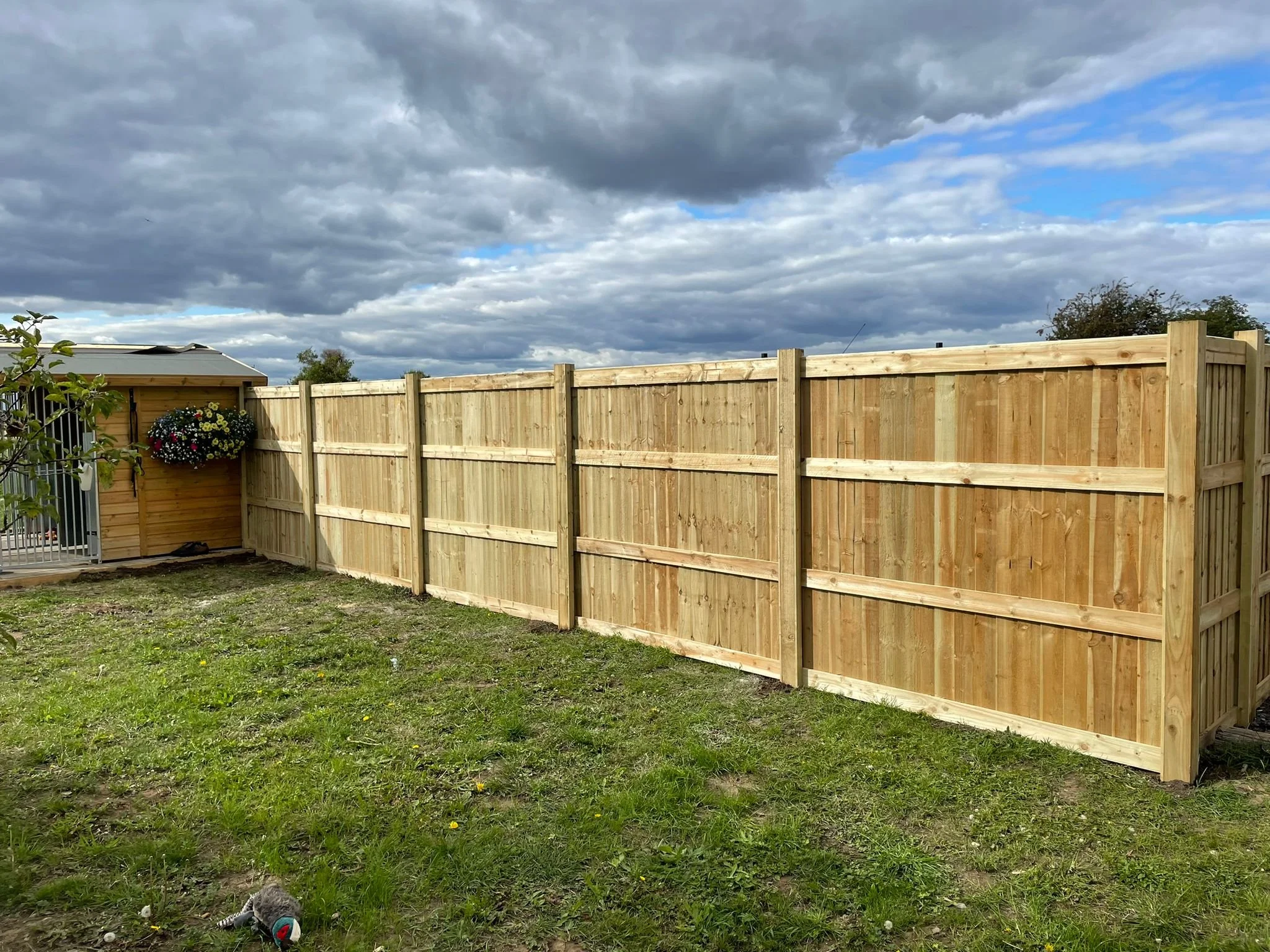
You can make almost any fence look good on the day it is installed. Get the line straight, level the panels, clean up the site and it photographs beautifully. The more meaningful test comes after a few Yorkshire winters, a wet spring and a prolonged dry spell. That’s when shortcuts underneath the surface start showing themselves, and why properly installed garden fencing has far more to do with what is happening below ground than most homeowners ever see.
I’ve always thought fencing is slightly unusual in that respect.
Customers naturally concentrate on the visible parts. They choose the panel, timber style, height, colour and perhaps whether they want timber or concrete posts.
A contractor should be thinking about the hole.
That isn’t particularly glamorous, but the hole will probably have more influence on how long the fence remains standing than the decorative detail at the top.
Yorkshire ground isn’t particularly forgiving
There is no single type of “Yorkshire soil”, and anybody pretending otherwise hasn’t dug enough holes.
Conditions can change dramatically over surprisingly short distances.
Around Barnsley and South Yorkshire you can encounter heavy ground that holds water, clay, compacted material, stone, rubble and areas that have been disturbed by previous development. Older properties can produce all sorts of surprises below the garden.
I’ve dug where I expected soil and found old concrete.
I’ve found bricks, rubble and previous fence footings exactly where the new post needs to go.
Then there are tree roots, drains and changes in level to deal with.
Newer developments aren’t automatically easier. Ground around recently developed properties can contain heavily compacted or disturbed material, and the conditions at one end of a garden aren’t necessarily identical to those at the other.
This is why I don’t like fencing installation being treated as a simple formula.
Dig hole. Insert post. Add concrete. Repeat.
The principle might be simple. Judging what is actually in front of you isn’t.
A shallow hole can look perfect for quite a while
One of the easiest shortcuts to hide is inadequate post depth.
Nobody sees it once the job is finished.
A post can be beautifully vertical. The panels can form a dead-straight line. The concrete can be neatly finished around the base.
If the footing isn’t adequate for the height and exposure of the fence, however, appearances don’t mean much.
The forces acting on fencing can be substantial. A solid panel catches wind across its entire surface and transfers that load through the rails or panel into the posts.
The taller and more exposed the fence, the more important the supporting structure becomes.
This doesn’t mean there is one magic post depth suitable for every garden. Fence height, post type, ground conditions, exposure and the construction of the fence all have to be considered.
What concerns me is when depth is dictated by convenience.
If somebody reaches difficult ground and decides that is deep enough simply because digging further has become hard work, the fence hasn’t suddenly become structurally sound.
The difficult bit is often exactly where the quality of the installation is decided.
More concrete isn’t always the clever answer
People sometimes assume a huge amount of concrete guarantees a strong fence.
Not necessarily.
Concrete needs to be in the right place and supporting a properly positioned post at an appropriate depth.
A large shallow footing can still perform poorly. Equally, pouring excessive concrete around every post can create problems for whoever eventually has to remove the fence.
I’ve excavated old footings where the amount of concrete seemed completely disproportionate to the post it was supporting.
That isn’t craftsmanship. It’s just a lot of concrete.
The aim should be a secure footing suited to the installation.
There is another consideration with timber posts. The point where timber enters the ground is particularly vulnerable because moisture conditions repeatedly change there. A post can look perfectly healthy higher up while deterioration is developing around its base.
Once that area weakens, a large concrete footing won’t make the timber above it magically stronger.
Water usually finds poor workmanship eventually
South Yorkshire gets enough wet weather to test a fence properly.
Drainage therefore matters.
Waterlogged ground changes the support around footings, while persistently damp conditions aren’t particularly friendly to timber. Gardens on slopes create another set of considerations because water doesn’t necessarily remain where you expect it to.
Watch a garden during heavy rain and you’ll often learn something about it.
Where does the water collect?
Does it run towards the boundary?
Are there sections that remain wet long after the rest of the garden has drained?
Is water coming from neighbouring higher ground?
Those observations matter when planning fence installation and other fencing services.
This is particularly important where somebody is replacing an existing fence that has failed. Simply putting the new posts in exactly the same places without asking why the old ones failed can mean repeating the original problem.
If three posts have deteriorated unusually quickly in the wettest part of a garden, I’d want to understand that before installing three replacements.
Sometimes the old fence isn’t just rubbish.
Sometimes the site is telling you something.
Dry weather creates a different test
Yorkshire rain gets plenty of attention, but dry periods can be revealing too.
As soil loses moisture, some ground contracts. Cracks can appear and support around existing footings can change. Clay is particularly associated with noticeable shrinkage and expansion as moisture levels fluctuate.
Then wetter weather returns.
That seasonal cycle can expose a marginal installation.
A well-installed fence should cope with normal changes in ground conditions, but a shallow or poorly formed footing has less tolerance when the surrounding soil begins moving.
This is why a fence that has stood reasonably straight through summer can sometimes start leaning during autumn.
The wind may appear to have caused it.
More often, the wind has simply revealed how little resistance was left underneath.
Sloping gardens need thought, not improvisation
Barnsley isn’t exactly famous for being flat.
Sloping gardens are common, and fencing across changing levels needs planning before installation begins.
There are different ways to deal with a slope depending on the fencing system and the severity of the gradient. Panels may be stepped, while some forms of fencing can follow the ground more closely.
What shouldn’t happen is reaching the slope halfway through the job and making it up as you go along.
Poorly considered stepped fencing can leave awkward gaps underneath panels, inconsistent heights and posts carrying loads in ways that weren’t properly anticipated.
Ground levels also affect post installation itself.
If soil is likely to be altered later for landscaping, decking, patios or retaining work, that needs discussing. Changing the level around an existing post can alter drainage and expose timber to conditions it wasn’t originally installed for.
Gardens evolve.
Good fencing needs to account for what is already there and, where possible, what is likely to happen next.
Old industrial areas can hide interesting surprises
Working around older South Yorkshire housing means occasionally discovering what previous generations left underground.
Barnsley has a long industrial history, and many residential areas have been altered, extended and redeveloped over decades. Gardens aren’t pristine archaeological layers of untouched soil.
They have had sheds, paths, walls, garages, washing-line posts and previous fences.
Sometimes several previous fences.
When an old post is removed, there may already be a substantial lump of concrete occupying exactly the position required for its replacement.
The tempting shortcut is to move the new post slightly to one side.
Do that repeatedly and the entire fence line starts moving.
Another shortcut is to leave most of the old footing in place and attempt to fix around it. There are circumstances where existing material can sensibly be worked with, but convenience shouldn’t automatically dictate the decision.
Removing old concrete is hard work.
That doesn’t make leaving unsuitable concrete underground a good idea.
Exposed boundaries magnify small mistakes
A sheltered garden between houses and a boundary overlooking open countryside are completely different environments.
Barnsley has plenty of properties towards the edges of built-up areas where gardens meet fields or open land.
Wind matters enormously in those locations.
A minor weakness that might survive for years in a sheltered garden can reveal itself quickly when a six-foot fence is regularly taking the full force of the weather.
Panel choice can matter too. So can spacing, post specification and the general construction of the fence.
I would rather install modest fencing properly than expensive fencing on inadequate foundations.
The ground doesn’t care how much the panels cost.
Repairs can reveal what went wrong
One of the useful things about carrying out fence repairs is that you get to see installations after they’ve been tested by real life.
New fencing tells you what somebody intended.
Broken fencing tells you what actually happened.
A rotten post at ground level is easy enough to understand. Several leaning posts along the same run might suggest something different. Repeated failures after windy weather could point towards inadequate support for an exposed location.
Sometimes you remove a failed post and immediately understand the problem.
The footing is tiny.
Or shallow.
Or the post has barely penetrated the ground.
Other failures are simply age. Nothing lasts forever, particularly timber exposed to British weather for years on end.
Being able to tell the difference matters because it determines whether repair is sensible.
If one component has failed in an otherwise sound fence, repairing it can be perfectly reasonable.
If the entire installation was fundamentally inadequate, repeatedly repairing individual sections may just move the next failure further down the boundary.
The boring parts are usually the important ones
Homeowners rarely get excited about post holes, drainage or footing depth.
I can’t blame them.
Nobody invites the neighbours round to admire how well a fence post was concreted into the ground.
But those boring details are what keep the visible fence upright.
Yorkshire weather is very good at sorting installations that merely look good from installations that were built properly. Wet ground, dry ground, frost, wind and ordinary seasonal movement provide a fairly relentless test.
There isn’t much opportunity to bluff it indefinitely.
A straight fence on completion day is nice.
I am much more interested in whether it is still straight after five winters.